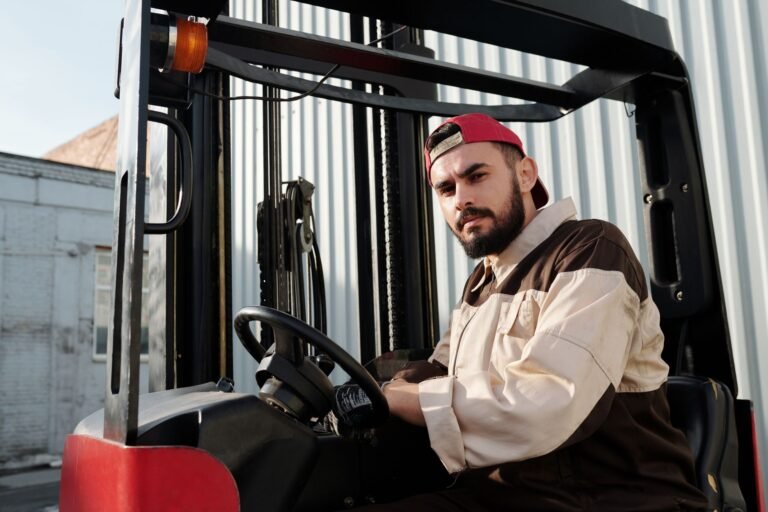

According to Indeed Ireland, the average forklift operator earns €15.63 per hour, based on 924 salary reports updated in March 2026.
Furthermore, unlike many manual roles, forklift driving does not require a standard motor-vehicle driving licence, as long as the vehicle stays within a private workplace rather than on public roads.
What Does a Forklift Driver Do?
Loading, stacking, and moving materials safely — a role that combines physical skill with constant attention to safety
Core duties on a typical shift
A forklift driver operates a lift truck to move, stack, and transport goods within a warehouse, distribution centre, or manufacturing facility. Core duties include loading and unloading delivery vehicles, picking and placing stock at height, building and breaking down pallets, and moving materials between storage areas and production lines. Furthermore, drivers conduct daily pre-shift safety checks on their vehicle, report any faults immediately, and maintain accurate records of stock movements using scanners or paper-based systems depending on the employer. Additionally, drivers work closely alongside warehouse operatives and pickers, meaning strong spatial awareness and clear communication matter just as much as raw driving skill.
Where forklift drivers work
Forklift drivers find employment across a wide range of sectors in Ireland. These include large distribution and logistics centres, pharmaceutical and food manufacturing facilities, construction sites, retail distribution hubs, and ports. Moreover, the specific demands of the role vary by setting: pharmaceutical manufacturing typically requires GMP awareness alongside forklift skills, while construction site forklift work often involves rougher terrain and outdoor conditions compared to a controlled warehouse environment. Consequently, candidates entering the role should consider which sector best matches their interests, since the day-to-day environment differs considerably between settings.
Safety as a core part of the job
Forklifts rank among the most hazardous vehicle types in any workplace, a risk that is often underestimated precisely because they are quiet and in frequent, routine use. Therefore, safety awareness is not a secondary consideration but a fundamental part of the role itself. Drivers must remain constantly alert to pedestrians, blind spots, uneven loads, and changing floor conditions, and they are legally required to operate only within the scope of their specific certification. As a result, employers consistently prioritise a careful, safety-conscious attitude over speed when assessing candidates.
- Masterlift — Forklift Licence Rules & Requirements in Ireland — Clear explanation of Irish forklift licensing law and the HSA’s Code of Practice
Getting Certified: The Forklift Licence Explained
No driving licence needed — but a short, accredited training course is a legal requirement before anyone can operate a forklift
The legal basis for forklift training
The Health and Safety Authority (HSA) publishes a Code of Practice covering Rider-Operated Lift Truck Operator Training, which sets the standard for forklift training across Ireland. Importantly, there is no legal requirement to hold a standard motor-vehicle driving licence to operate a forklift, provided it stays within a private workplace rather than on public roads. However, employers carry a legal duty under the Safety, Health and Welfare at Work Act to ensure that only trained and competent people operate forklifts. Consequently, what most people refer to as a “forklift licence” is, in practice, a training certificate issued by an accredited provider confirming successful completion and assessment.
RTITB accreditation: the recognised standard
Most accredited Irish training providers operate under RTITB (an internationally recognised forklift training accreditation body), with instructors registered and qualified specifically to prepare and examine operators. Furthermore, several providers hold dual or triple accreditation, including RTITB, SOLAS, and the RSA, giving candidates added confidence in the certification’s recognition across the sector. Therefore, when comparing training providers, checking specifically for RTITB accreditation is the clearest way to confirm a course meets the industry-recognised standard that most Irish employers expect.
Novice, conversion, and refresher courses
Training providers structure courses around experience level. A novice course, typically running three to five days, suits candidates with no prior forklift experience and covers theory, supervised practical training, and a formal assessment. A shorter two-day conversion course suits experienced operators who have hands-on experience but lack formal certification. Additionally, a one-day refresher course allows certified operators to renew their qualification, which the HSA recommends periodically to prevent bad habits from developing over time. Moreover, candidates must be at least 18 years old to undertake any forklift training course under current Irish health and safety regulations.
Funding support for training costs
A standard five-day novice course costs approximately €750 at established providers such as EDST Kildare, though prices vary by provider, location, and the specific truck types included. Notably, Training Support Grants from the Department of Social Protection are accepted by several providers, which can significantly reduce the upfront cost for jobseekers pursuing this qualification independently. Furthermore, many employers fund forklift training directly for new staff, particularly in warehouse and logistics roles where the certification is treated as an essential job requirement rather than an optional extra.
- Irish Safety Centre — How to Obtain a Forklift Licence in Ireland — Step-by-step guide to forklift certification, costs, and HSA compliance
Salary in 2026: What Forklift Drivers Earn
€15.63 per hour average, rising significantly with multi-truck certification and sector specialisation
What the data shows
Indeed Ireland’s data, based on 924 salary reports, shows an average forklift operator hourly rate of €15.63. ERI SalaryExpert’s broader Irish data places the average annual pay considerably higher at €39,503 per year, equivalent to roughly €19 per hour, with a typical range of €29,548 to €46,456 depending on experience and sector. This gap between sources reflects how heavily pay varies by employer type — general warehouse roles tend to sit closer to the Indeed average, while specialist sectors such as pharmaceutical manufacturing or large-scale port and logistics operations push pay considerably higher. Therefore, a realistic expectation for a certified forklift driver in Ireland in 2026 ranges broadly from €30,000 at entry level to over €45,000 in higher-paying specialist sectors.
How certification breadth affects pay
Holding certification across multiple truck types genuinely increases earning potential and job opportunities. Operators certified on Counterbalance, Reach Truck, and Power Pallet Truck simultaneously can apply for a wider range of roles than those holding a single certification, since many warehouses use more than one truck type across different operational areas. Furthermore, specialist certifications — such as Order Pickers, Articulated Forklifts, or 4-Directional Forklifts — open additional, often better-paid opportunities in high-bay or narrow-aisle warehouse environments where these specific vehicle types are essential.
Shift premiums and sector differences
As with most warehouse and logistics roles, night shift and weekend premiums apply at most employers, typically adding 10–20% to the base hourly rate. Moreover, pharmaceutical and food manufacturing employers often pay above the general warehouse average, reflecting both the regulatory environment and the additional training operators must complete to work safely within GMP or food-safety-controlled environments. Consequently, candidates aiming for the higher end of the pay scale should specifically target these regulated manufacturing sectors rather than general distribution warehousing.
- ERI SalaryExpert — Forklift Operator Salary in Ireland — Detailed salary range data for forklift operators across Ireland
Types of Forklift & Where the Demand Is
Counterbalance, Reach Truck, and Power Pallet — the three most common types, each suited to different warehouse environments
Counterbalance forklifts
The Counterbalance forklift is the most widely recognised and commonly used type in Ireland, suited to general warehouse and yard work, loading delivery vehicles, and moving palletised goods across open floor space. It is typically the first certification new operators pursue, since it forms the foundation for most entry-level warehouse and logistics roles. Furthermore, most novice training courses include Counterbalance certification as standard, often bundled together with Reach Truck and Power Pallet Truck training in a single programme.
Reach Trucks
Reach Trucks are designed specifically for high-rack warehouse environments, allowing operators to lift loads to significant heights within narrow aisles. This certification is particularly valuable in large distribution centres operated by major logistics employers, where vertical storage maximises warehouse capacity. Moreover, Reach Truck certification often commands a slight pay premium over Counterbalance-only certification, given the additional precision and spatial awareness the role demands.
Power Pallet Trucks and specialist types
Power Pallet Trucks (PPTs) handle lower-level pallet movement and are frequently used for short-distance transport within a single warehouse zone, often alongside other truck types rather than as a standalone role. Beyond these three core types, specialist certifications including Order Pickers, Articulated Forklifts, and 4-Directional Forklifts serve specific high-density or narrow-aisle warehouse designs. Therefore, candidates targeting roles at major employers in pharmaceutical, e-commerce, or large-scale retail distribution should research which specific truck types those employers use before choosing which certifications to pursue first.
- ISM Training & Recruitment — Forklift & Equipment Courses — RTITB, SOLAS, and RSA-accredited forklift training across all major truck types in Dublin
How to Find Work
From recruitment agencies to direct warehouse applications — here is how to find a forklift driving role once certified
Specialist recruitment agencies
Specialist logistics and warehouse recruitment agencies actively place certified forklift drivers into both temporary and permanent roles across Ireland. ISM Recruitment, for example, operates specifically within the Driver, Warehouse, and Logistics sectors, giving newly certified operators direct access to active vacancies through the same organisation that may have provided their training. Furthermore, registering with two or three agencies simultaneously broadens exposure to roles that are not always advertised publicly, since many warehouse employers rely heavily on agency relationships to fill operational vacancies quickly.
Direct applications to major employers
Large logistics, manufacturing, and retail distribution employers in Ireland recruit forklift drivers directly through their own careers pages and via Indeed Ireland. When applying, candidates should clearly state which truck types they hold certification for, the issuing training provider, and the certification date, since this information allows hiring managers to quickly confirm suitability for the specific role advertised. Additionally, mentioning flexibility around shift patterns — particularly willingness to work nights or rotating shifts — strengthens an application considerably, given how common shift-based scheduling is across Irish warehousing.
Building experience and progressing
Many experienced warehouse operators and team leaders began their careers as certified forklift drivers, since the role provides genuine, practical insight into warehouse operations that supports later progression into supervisory positions. Furthermore, operators who pursue additional certifications over time — moving from a single truck type to multiple, or adding specialist equipment qualifications — typically access better-paid roles and a wider pool of available vacancies. Consequently, treating the initial certification as the starting point of a broader logistics career, rather than a fixed endpoint, tends to produce stronger long-term earning outcomes.
- Indeed Ireland — Forklift Operator Salaries & Jobs — Live salary data and current forklift operator vacancies across Ireland
Training Course Comparison Table
Novice to refresher — how the main forklift training course types compare on duration, cost, and who they suit
Choosing the right course
The right course depends entirely on prior experience. Complete beginners need a full novice course covering theory, practical instruction, and formal assessment from the ground up. Those with informal hands-on experience but no certification can typically complete a shorter conversion course. Meanwhile, already-certified operators simply need periodic refresher training to maintain their qualification and stay current with safety best practice. The table below summarises the main course types available across accredited Irish training providers in 2026.
| Course Type | Duration | Typical Cost | Suitable For |
|---|---|---|---|
| Novice (3 trucks) | 3–5 days | ~€750 | Complete beginners, no prior experience |
| Conversion / Experienced Operator | 2 days | €300–€500 | Hands-on experience but no formal certification |
| Refresher | 1 day | €150–€250 | Certified operators renewing qualification |
| Specialist (Order Picker, Articulated, 4-Directional) | 1–3 days | Varies by provider | Certified operators adding niche truck types |
Novice (3 trucks)
Duration: 3–5 days
Cost: ~€750
Suitable For: Complete beginners, no prior experience
Conversion / Experienced Operator
Duration: 2 days
Cost: €300–€500
Suitable For: Hands-on experience but no formal certification
Refresher
Duration: 1 day
Cost: €150–€250
Suitable For: Certified operators renewing qualification
Specialist Certifications
Duration: 1–3 days
Suitable For: Certified operators adding niche truck types